Saturday, 6 September 2014

6 Sep 2014. <GB-ENG> Dorchester, & Cerne Abbas, & Sherbourne, Dorset —
Woke up rather lazily, as we didn't have far to go to our first destination, Max Gate, the house Thomas Hardy designed (he had apprenticed as an architect), built, and lived in until his death. The traffic on the A35 looked rather horrific, and we found out why as we were driving into Dorchester. The Dorset County Show was on here today, and it looked like the entire population of the county was gravitating towards the site. The Garmin was trying to get us to turn onto the one road all the show traffic was taking, so we decided to override it and take the next turnoff. Good choice — the next turnoff took us straight to the front gate of Max Gate.


We wandered the house, found out a lot more about Thomas Hardy and his family, and his circle of friends — which reads like a Who's Who of late 19th century and early 20th century society. For example, the eight pallbearers at his funeral in 1928 were James Barrie, John Galsworthy, Edmund Gosse, A.E. Houseman, Rudyard Kipling and George Bernard Shaw, all representing the literary world; and Stanley Baldwin and Ramsay MacDonald (the prime minister and the leader of the opposition), both representing Parliament. Others who dined at Max Gate included Lady Cynthia Asquith, the sculptor Sir Hamo Thornycroft (whose wife Agatha is said to be the inspiration for Tess of the d'Urbervilles), the poet Robert Graves, and Edward, Prince of Wales.

The National Trust only took over the running of this property about 5 years ago, so it is in the early stages of development. One room, for example, started out as Thomas' study, but then he converted it into his bedroom (putting his study elsewhere in the house), and in fact he died in this room. The Trust has not yet decided whether to present this room as a study or as a bedroom — and they are asking for input from visitors. And the garden, which was considerably disrupted by his second wife Florence after his death, is only just in the planning stages of reconstruction. Nevertheless, we had a most enjoyable time wandering the garden, which is currently a fairly typical English country garden.

We departed Max Gate and Dorchester, going northwards up the A352, to the village of Cerne Abbas. This village is renowned for an old earth carving, cutting the turf away to reveal the white chalk beneath it. Many such carvings are of White Horses, which we intend to visit later, but this one is the "Cerne Giant", a massive human figure cut into the ground.
The problem is, nobody knows its age. There is no reference to the giant in historic documents before 1694. One theory is that it represents Hercules, and is over 1500 years old; another is that it is a caricature of Oliver Cromwell, and is only about 350 years old. Whatever its age, it is 60 metres tall and 51 wide. While we were here, there were church bells pealing across the countryside, and we found that a wedding had just taken place and the reception was in the village hall, right beside where we were parked.

We had lunch in the van, then walked the path up to Giant's Hill — you can't actually get near the carving, as the terrain is too fragile and is being protected most carefully.

After this, we decided to go northwards, towards a White Horse and an Iron Age hillfort at Bratton — but we won't get there today. Instead, we dropped off at Sherbourne Castle, really a country manor built by Sir Walter Raleigh, but which he had to surrender to the crown prior to his execution for treason in 1618 (by which time the castle was in the hands of its new owners, the Digby family). The Digby family (or now the Wingfield Digby family since William Wingfield married Lady Charlotte Digby in 1796) are still in residence, but they have opened the mansion to the public since 1969. The house is fabulous, and worthy of detailed exploration, but the gem of the place is its garden — this one was actually designed by Lancelot 'Capability' Brown between 1753 and 1776.
There is one remnant of Sir Walter Raleigh here — a seat he had constructed that overlooks the road, so he could sit and look over his garden while also watching the traffic on the old road to Dorchester. Talking about weddings, there was one going on here as well — we could hear raucous laughter from the marquee as we walked around the lake — presumably the Best Man was making his speech! We also met this lovely Dorset gentleman, 87 years old and walking his 20-week-old Yorkshire Terrier puppy, Mitzi. Mitzi was the friendliest little pooch you could ever meet, and just loved having her tummy rubbed. Watch out, Bibi — you might well get a sibling when we get home!


Anyway, we left Sherbourne and drove on, just happening on a layby well off the A30 as we were approaching Shaftesbury.

Distance driven — today, 35 miles ( 57 km ); to date, 7,169 miles ( 11,538 km )

Friday, 5 September 2014

5 Sep 2014. <GB-ENG> Exmouth, Devon; Higher Bockhampton, Dorset —
Today was mainly travel — we are trying to set ourselves up for Stonehenge in a couple of days. We drove eastwards, towards Exeter — quite a way in English terms (a drop in the bucket for Aussies!). Our first destination was A La Ronde, a very quirky late 18th century house built by two very rich maiden cousins after they returned from their Grand Tour of Europe (in a time when only males made this journey!). They had been much impressed by the octagonal basilica in Ravenna, so they decided to base their home on this design. The interior room is indeed octagonal, but the exterior goes one better — it is hexadecagonal! 16 sides! And it works in its own eccentric way.

The house had another quirk — it was only to be left to unmarried women, and any who subsequently married were to be evicted. This only really worked for about 40 years, and meant the house could only be passed sideways, to unmarried female relatives. After about 1840, this proved to be impossible and it came into the hands of a male relative, a defrocked clergyman, who still called himself the Rev. Oswald Reichel. He made considerable alterations to the house — all positive! — and made the upstairs a most liveable area, as opposed to the simple storeroom it was previously. He also made the most of the views out to the River Exe estuary. Most of the contents of the house reveal the Parminter cousins' ability to hoard souvenirs.
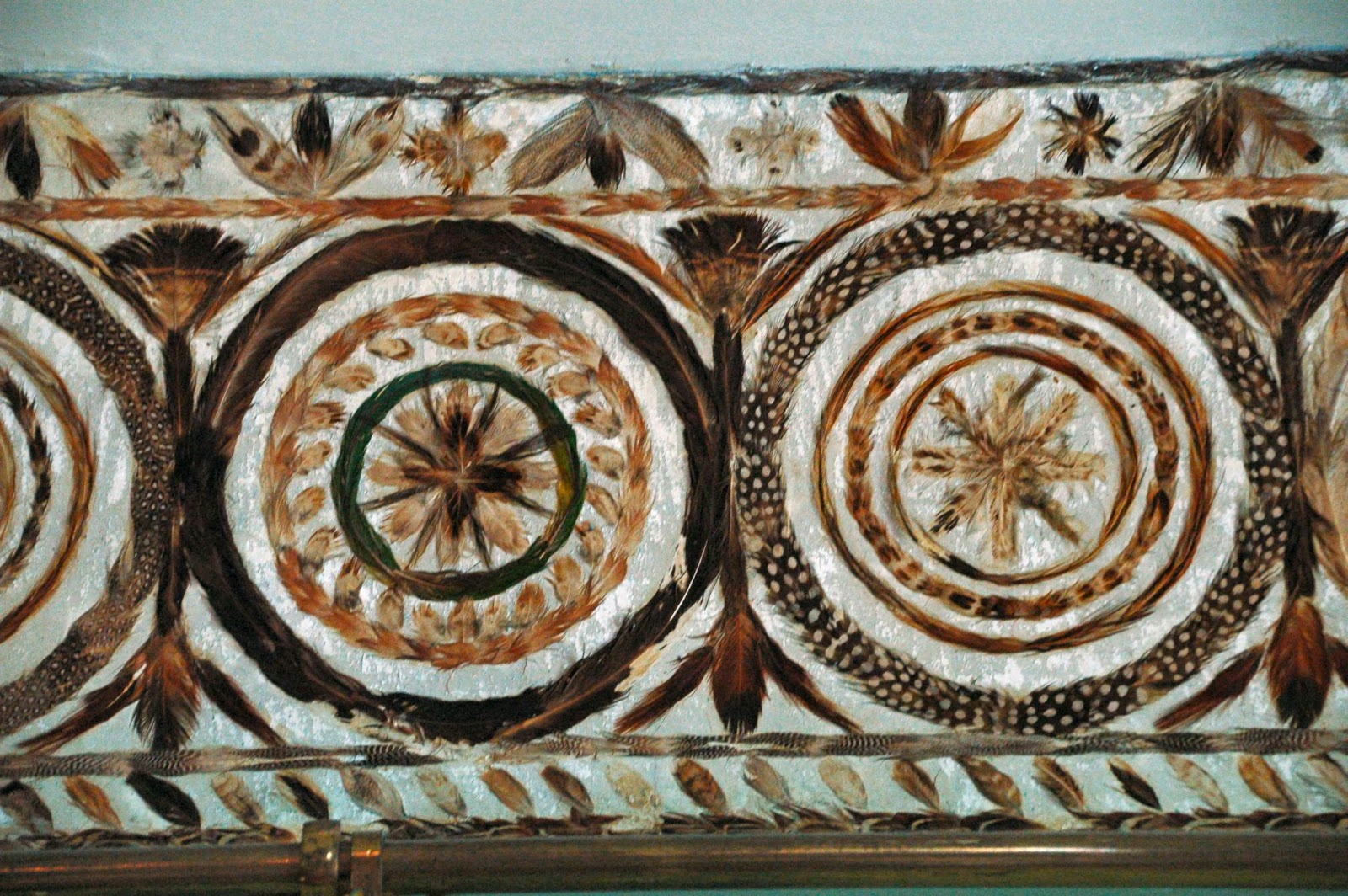
They also were wonderful craftswomen, who created friezes in the house by gluing bird feathers to the cornices and, having seen a shell grotto in Italy, they set up a large shell gallery in what would have been the attic. This gallery is so fragile today that it is not directly accessible, but there is an interactive computer display to allow you to explore it virtually.


So, after a couple of hours of exploring the epitome of English eccentricity, we left Exmouth and pointed ourselves towards a more classical destination — Thomas Hardy's Cottage, the birthplace of Thomas Hardy, near Dorchester. It took a while, and it was within an hour of closing when we got there. This was enough time to look over a 6-room cottage and its garden. We went through the place, and had a good conversation with the people who were gathered in the parlour, just chatting. This is the way of the Hardy place — you relax and enjoy the conversations, as the Hardys did in the 1800s. The parlour was the most-used room in the house then, and it still is now! The Hardys were a most musical family, as could be seen from the violins, recorders and mandolins evident downstairs. We were able to visit the room in which he was born — and in which, on one fateful morning, he was found sound asleep in his crib with a live snake lying beside him! His own room, as he grew up, was the one next to his parents' room. There's nothing really much to see — as with most writers, the home is of interest when you want to see his origins, but it was what he did with his imagination later on that really tells.

We left the cottage as it closed at 5pm, and went out to a layby we had seen on the way to the cottage — really quite close. We didn't want to go too far, as Hardy's home as an adult is in Dorchester, and we can visit it tomorrow before beginning to indulge in older art and culture, as we explore various incised chalk figures in the Dorset and Wiltshire areas, before going on to the splendour of Stonehenge.

Distance driven — today, 94 miles ( 151 km ); to date, 7,134 miles ( 11,481 km )

Thursday, 4 September 2014

4 Sep 2014. <GB-ENG> Plympton, Plymouth City —
A day that started out much as yesterday, with a haze that never really left us. We drove a considerable distance eastward, to Saltram House, a National Trust estate just out of Plymouth. The Garmin took us on a rather hair-raising journey through narrow lanes, but we finally got there, in time for lunch!

We went straight in to the café, where Susie was going to have a scone and Warren a pasty — "Sorry, pasties are off, love" — so Warren had a mushroom and garlic rarebit instead.

Then we went in to the house itself. This is a Georgian mansion, built and furnished by the Parkers, an ambitious family who served in Parliament, in the royal court, and on the battlefield (particularly in the Boer War). There's a great comment in the guidebook — "Some made money, others married money and several were very adept at spending money."

The exterior of the house is Palladian, in light Mediterranean colours. It sits in grounds that fully complement its style. The gardens are truly magnificent, having been much influenced by Nathaniel Richmond, a protégé of the legendary Lancelot 'Capability' Brown who pioneered the English style of garden landscaping.
We walked out along an avenue of lime trees till we found a folly in the form of a castle. The folly is basically a very comfortable, sunny room that takes full advantage of the views across to the River Plym — but it has a generous fireplace, so you could also enjoy the cooler autumnal days from this vantage point.

Within the house, two of the rooms of the house were designed by Robert Adam (the saloon and the library, now the dining room) and are amongst the finest of his work. On the ground floor, one of the main impacts is the plasterwork. The ceilings and the walls are resplendent with Graeco-Roman gods and putti (cherubs) involved with the arts. There are paintings by Sir Joshua Reynolds, Angelica Kauffmann and by Rubens. There's furniture by Chippendale — and a lot of Wedgewood porcelain. In short, the whole place epitomises the best of late 18th century fine and decorative arts. A pleasant piece of news — apparently the National Trust has now relaxed its blanket ban on photography within its properties, so Warren was able to take quite a few shots inside the house.


After spending a couple of hours being totally blown away by the spendour of this place, we left to make our way further afield — mainly to do a 3-day shop, and then spend a little time at Macca's to bring the blog further up-to-date. (Please bear in mind the considerable sacrifice Warren makes, enduring MacDonald's food in order to keep you guys up-to-date with our travels!) We then went on to a layby on the A380, just short of the River Teign — not one of our best stops, as the traffic was heavy, constant, fast, and close — but we slept through it all!

Distance driven — today, 111 miles ( 178 km ); to date, 7,040 miles ( 11,330 km )

Wednesday, 3 September 2014

3 Sep 2014. <GB-ENG> Falmouth, Corn —
A strange day. Dawned with a cloudy sky and a mist, not dense, but most noticeable. Drove into Falmouth, to Pendennis Castle, but did not find the carpark at first (the Garmin insisted on taking us to the Disabled Parking). Drove back out and parked at the top of Cliff Road. Turning our heads, we saw a sign pointing towards the car park. Turned the ignition — nothing! The van's battery was totally flat. Couldn't believe it — we had started up without incident this morning, driven 12 miles into Falmouth, turned off the car — and then nothing! The only reasonable explanation was that we had thrown our alternator belt, or else the alternator had given up the ghost. A call to the RAC, and an hour or so later the mechanic arrived. This was not his usual patch — he was based in Bodmin, about 50 miles away, but he was the nearest available, and he didn't mind a little drive to the seaside!

While we were waiting for him to arrive, we enjoyed the foreshore at Falmouth. The mist/haze was deepening, and some of the ships anchored offshore, unable to proceed in such limited visibility conditions, made their presence felt when their automatic foghorns started to sound. We knew what was happening, because the attendant at Lizard Point Lighthouse, which has the same sort of system, had explained that fog will activate the foghorns, but so will some moisture in the wrong place, or smoke — almost anything that gets between the two sensors.

Turned out that the alternator belt had failed, and was lying doggo in the bottom of the drip tray under the motor. He didn't have the right belt on board, but a source 10 minutes away had one. To cut a long story short, after about another 40 minutes we were mobile again, and had made another friend in Cornwall!

We drove out of Falmouth for about 5 miles, and about 5 miles back (to make sure we had recharged the battery), called in to a Lidl to pick up some freshly-baked bread rolls (they were really great!), and then went up to Pendennis Castle car park, where we had the bread rolls with pastrami, ham and cheese for lunch — it might not sound much, but with first-rate ingredients, it's a magnificent repast! — before we walked round to the Castle.


Pendennis Castle is strange. There is this little round fortress set in what appears to be a vast parkland. This is a Tudor gun emplacement, constructed in the time of Henry VIII, and worked in concert with St Mawes Castle on the opposite headland to protect Falmouth Harbour, one of the world's major deepwater harbours, from invasion by the French or the Spanish. (Falmouth is third in size to Sydney Harbour and Rio de Janeiro.)

In the second level of the Castle there is a display of a typical firing action — as we went into the Castle, we were wondering why there was so much gunpowder smoke inside it, and this explained everything! The whole site is so important that it was kept fully functional, with appropriate improvements, right up to 1956 when it was decommissioned. The last guns to be installed here were a pair of experimental long-range guns in the half-moon battery, that had a range of about 15 miles, and were only in action for the last 6 years of the fort's activity. (The half-moon battery was set up in 1793, considerably closer to the headland to gain an increase in range, and subsequently became the main gun emplacement for the site.)

Inside the Storehouse (now the English Heritage ticket office and store) there is an exhibition of cartoons by George Butterworth from the Second World War. He so lampooned Hitler and Mussolini that Hitler had him put on his 'hit-list'. The cartoons are even more fascinating because in the margins are instructions to the engravers to ensure that the printed result was exactly as Butterworth wished.

We had a wonderful afternoon here, its quiet and calm probably a result of the mist, which permeated the whole day — it was misty, but sunny — beautiful! We're not sure the ships stuck outside the harbour would agree though!

While we were at Pendennis Castle, we asked when we need to phone the powers that be to arrange for early access to Stonehenge, which is not far from here. We were told that calling on the day before would be sufficient, so we have laid into our plans a visit to Stonehenge in the next week.

After this, we left to travel a little further east, and have parked off just past Truro in a layby that is well secluded by an embankment and trees from the highway nearby.

Distance driven — today, 36 miles ( 58 km ); to date, 6,929 miles ( 11,152 km )

Tuesday, 2 September 2014

2 Sep 2014. <GB-ENG> Mount's Bay, & Lizard Point, Corn —
Today was our chance to go over to St Michael's Mount. The day dawned beautifully, sunny and pleasant. We drove across to Marazion, a little east of Penzance, off which lies the island of St Michael's Mount.

The Gardens, from above

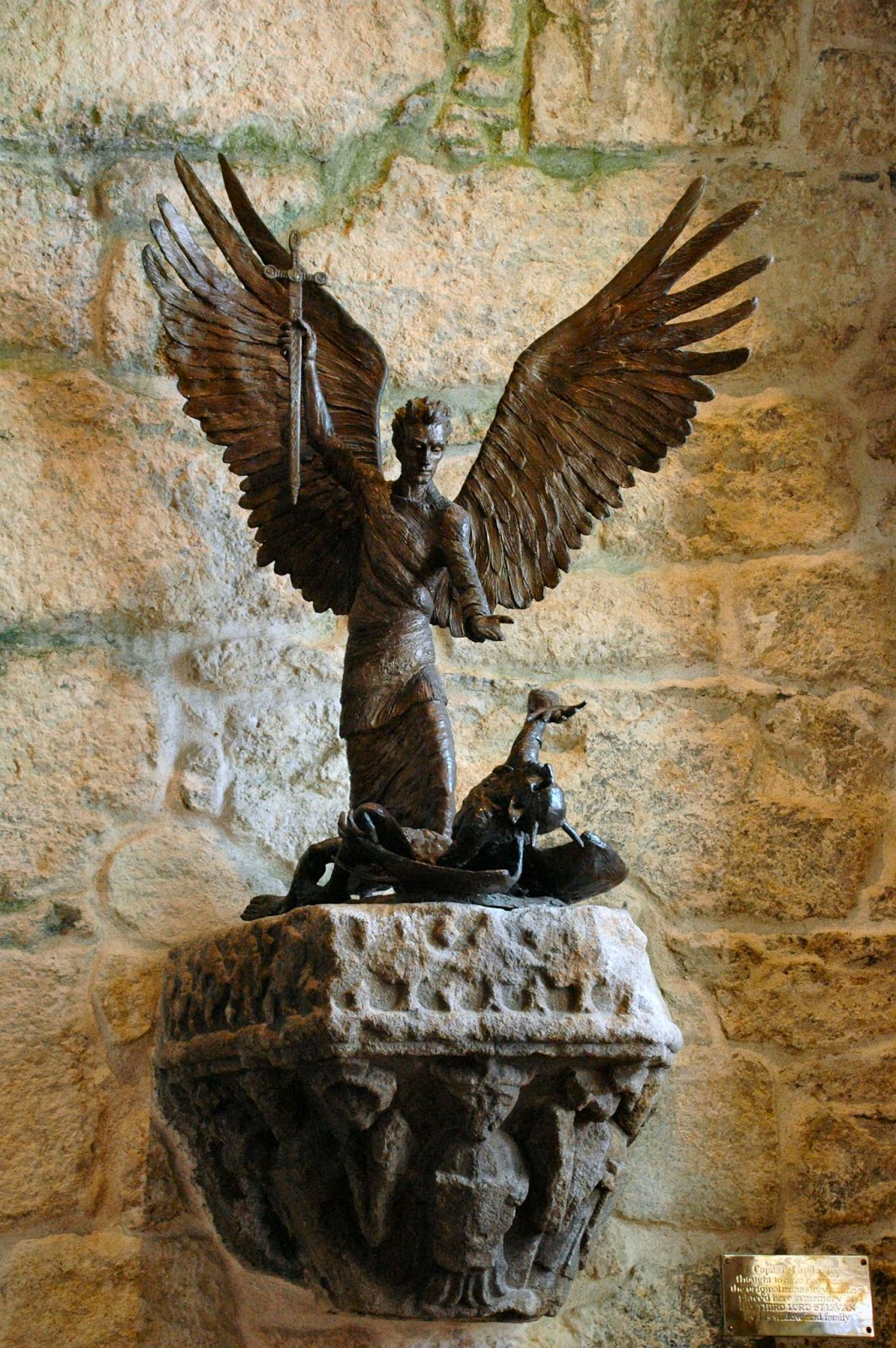
St Michael, in the chapel

A room in the castle
We parked in the carpark, walked along the waterfront to one of the docks where little boats put out for the Mount. (At low tide, you can walk out there on a causeway, but our timing was just not right for that — anyway, the boats are fun!) By the way, St Michael's Mount is very similar to Mont-St-Michel off the coast of France, and with good reason — in about 1080 the island was granted to Mont-St-Michel, so the two have a close history. In 1135 the building of the Church on St Michael's Mount was begun under the authority of Abbot Bernard Le Bec of Mont-St-Michel. With the dissolution of the monasteries under Henry VIII the island began a long period of secular ownership (and is still in the hands of the St Aubyn family and the National Trust today). In 1588 the lookouts here were the first to spot the Spanish Armada, and the beacon lit here became the first of a long line of signal fires which ultimately alerted London of the Armada's arrival. We went through the castle and then through the church, both of which are in use to this day.

The causeway, underwater


Then we decided to go in a different direction, literally. Land's End was the complement of John o' Groats, one being the furthest southwest, the other the furthest northeast, on the British Mainland. But we had also been to Dunnet Head, the furthest north, so the furthest south is — wait for it — Lizard Point, just a little south-east of Penzance. So we drove down there, to a very pleasant surprise.
It is not commercialized like Land's End, and there is a lighthouse here, one of the most important in the UK, being the main light at the eastern end of the English Channel. It has an intensity of 8 million candle power, and a range of 26 miles. It's also used as a major ground station for the world's GPS grid.
We went on a tour of the light with its current attendant — this is one of the few operational lighthouses that you can go into. While we were looking over the lighthouse,
we were overflown by a couple of helicopters from the nearby RNAS Culdrose, which operates the search and rescue service in this area, but also operates antisubmarine surveillance. The helicopters had slung beneath them pods with sophisticated surveillance equipment. We also watched a navy vessel powering its way past.
We then left Lizard Point and drove towards Falmouth. Perhaps we will drop in and look at Pendennis Castle there tomorrow, but in the meantime we've found a good layby off the A394 on the way, and are spending the night here.

Distance driven — today, 47 miles ( 76 km ); to date, 6,893 miles ( 11,094 km )

Monday, 1 September 2014

1 Sep 2014. <GB-ENG> Penzance, Corn —
Today dawned rather strangely (although, according to reputation, not so strangely for Cornwall). There was a fairly deep fog, which felt like a penetrating drizzle. Apparently there's a word for it here — 'mizzle'.

We decided to have a housekeeping day. We went in to Penzance, parked, found a laundry and organised to get our laundry done. Apparently it was the attendant's 24th wedding anniversary, and she was looking forward to a pleasant night out with her husband — so we returned to pick up the laundry at about 4pm to give her plenty of time for her night out!

While waiting for the laundry, we dropped over to Macca's so Warren could catch up a little on the blog. We would have gone over to St Michael's Mount, off the coast at Penzance, if we could see it. But today was mizzly, and the Mount only loomed occasionally out of the mist.


Warren's been here before?

Low tide at Penzance
We went back into Penzance. We walked a short way round the beachfront. There's a sea wall that really intrigued us — it's concrete, and curved like a breaking wave so as to throw back severe waves during storms. We then walked the streets to get a feel for the place. There are many stores run by the various charities. We took our parcels containing the collected books from our various destinations over the past couple of months, intending to post them home.
The way we had packed them, each of the two 6kg boxes would have cost nearly £100 to post. We were advised that, if we packed into 3 boxes, each under 5kg, we could take advantage of print post, with each 5kg parcel costing only about £30 to post — so, instead of it costing about £200 to post the lot, we would only have to pay £100. So we took the books back to the van, and repacked them.

St Michael's Mount finally put in an appearance!

We went back to the layby we camped in last night — it's so close, and so convenient. Turns out that there's a horse wagon with the same idea — but there's so much space here, that this is not a problem!

Distance driven — today, 20 miles ( 32 km ); to date, 6,846 miles ( 11,018 km )