Thursday, 7 August 2014

7 Aug 2014. <GB-SCT> Edinburgh, & South Queensferry, Edinburgh, & Edinburgh —
Today we checked out of Mortonhall — but not before a couple of interesting experiences. Arriving, to park where we were, was "Rotel Tours — Das Rollende Hotel". This is a German tour company which takes people on a coach tour, but which tows a rolling hotel behind — there are 52 little cubicles inside, for the non-claustrophobic tourist!

The other was a bus that parked near us, with a couple of adults and a heap of teenagers. Apparently this French couple, who run a holiday park in the north of France, had decided to take a busload of institutionalised kids for a touring holiday — the teenagers were camped in tents ranged up the nearby hillside. Today they were all going into Edinburgh to enjoy the Fringe Festival. Warren was talking to the woman, who was saying that they had no troubles with the kids, except for keeping up with their raging appetites for snacks! Full marks to them!!

We moved out, and drove through Edinburgh — yes, even on South Bridge and Princes Street (yay Susie!!) —
to Ocean Terminal Shopping Centre, beside which the now decommissioned Royal Yacht Britannia is moored. This is a fascinating thing to explore — when it was decommissioned, instead of scuttling her as was the previous procedure, she was put out for sale for public exhibition. Nothing was disturbed, and all the furnishings and paraphernalia that were on board on 11 December 1997 are still in place — only personal belongings were removed, and not even all of these! So we see the yacht virtually as the Queen walked off it on that day.

The whole ship is in immaculate condition — there is a legendary story of when the American General Schwartzkopf visited the yacht in 1992, on being shown the engine room, remarked "Okay, I've seen the museum piece. Now where's the real Engine Room?" The crew had to wipe their feet before entering this room, not on leaving it!

We were able to go round and look at the Queen's and the Duke's Sitting Rooms, the Royal Bedrooms, the State Dining Room, and on and on. The Royal section has the constant message of restrained splendour.


The State Drawing Room


The State Dining Room
The State Dining Room is no white elephant — it is still used for corporate dinners and other functions, and still operates to the same precision as when in the hands of the Royals — table settings, for example, are laid our precisely, with the aid of a ruler!


Firth of Forth Road Bridge
After having wandered the Royal Apartments and the crew areas for a few hours, we left for a last viewing of the Firth of Forth Bridges, to the northwest of Edinburgh. The modern road bridge is magnificent, but the real star is the Victorian Rail bridge, which has a regal presence. The first train crossed it in 1890. While we were there, a train crossed it at least every ten minutes.


Firth of Forth Rail Bridge
Beneath the bridge, on the waterfront, was a fun fair — after all, it is midsummer here in the UK! We wandered through it, and of course we indulged ourselves with an ice-cream cone!

Also, beneath the railway bridge, is an old inn — the Hawes Inn. If you are up with your Robert Louis Stevenson, you might recognise the name — it features in his novel "Kidnapped".

We got back to the van and set off for Northumberland — and got nowhere. Breakdown. The clutch was making horrid smells, and we had no power at all, couldn't even get up the next hill. We called the RAC, and when the fellow was able to find us — it took him a while, as the dispatcher sent him to the wrong part of Edinburgh to start with — he fairly quickly diagnosed the problem. Part of the gear linkage had failed, and when we thought we were choosing first gear, we were getting third. Not much use for starting up, even worse for handling hills! Anyway, he jury-rigged a temporary fix, which got us moving. He took the car for a test drive up the hill, and realised that the brakes were very suspect. But we were mobile, so he led us to a garage in the west of Edinburgh that does a lot of RAC work. By this time it was well after their closing time, so we camped there overnight and waited for them to open their doors next morning.

Distance driven — today, 28 miles ( 45 km ); to date, 5,450 miles ( 8,771 km )

Wednesday, 6 August 2014

6 Aug 2014. <GB-SCT> Edinburgh —
Once again into Edinburgh. Not such a promising day — fog and mist about, and a light rain right from the outset.

This time we went straight down to near the Greyfriars Church, where there is a famous little statue that any dog lover couldn't resist. It's the sad but beautiful story of Greyfriars Bobby, who when his master was buried in the Greyfriars Churchyard in 1858, took up a vigil near the grave and remained there until his own death, 14 years later, in 1872. The patrons of the nearby pub fed the dog, and he became a national celebrity. The statue was erected by the Baronet Burdett Coutts. You will notice that the nose of the statue is very well polished — it is traditional to touch the nose for luck.

We then walked up the road, past "The Elephant House". This is an inn frequented by authors, including J K Rowling (Harry Potter), Ian Rankin (Rebus) and Alexander McColl Smith (The No.1 Ladies' Detective Agency).

Next, into "Gladstone's Land", a 17th century apartment house on the Royal Mile. A fascinating glimpse of life in that period. Thomas Gladstone (or Gledstanes) was a merchant in Edinburgh who bought and moved into this property in 1617. He made a number of alterations to the building, virtually doubling its habitable area, that were complete by 1620. The whole place has been put back in time to its original appearance (though, fortunately with modern sanitation, not its original rather ripe aroma!). There was a cloth shop in the front on the ground level, and this has been reproduced. A most interesting hour or so!

We then went out. It was getting a little late to get over to the docks and the Royal Yacht 'Britannia' as we had planned, so instead we went into Debenham's for lunch, and then on to No.7 Charlotte Square. The buildings around this square were designed by Robert Adam, and are wonderful examples of the Georgian House. No.7 has come into the hands of the National Trust of Scotland, and so has been put back into its Georgian form, and is a delightful example of the home of a wealthy merchant of Edinburgh in the early 1800s. We had the added benefit, presumably because of the Edinburgh Festival, of a guitar duo sitting in the Drawing Room playing music of Scarlatti and his contemporaries. If you have read the books of the Brontë sisters — or watched the BBC dramatisations of them — you will be aware of the Sense and Sensibilities of the time.

From there we went into the West End Craft Market (part of the Edinburgh Fringe Festival) to explore the more than 100 stalls there — the craft work is beautiful, with some really novel ideas.

Then we returned to Mortonhall and the van. Tomorrow, hopefully, we will catch up with the Britannia, and then leave Edinburgh and start to turn our attention from Scotland to England!
Distance driven — today, nil ; to date, 5,422 miles ( 8,726 km )

Tuesday, 5 August 2014

5 Aug 2014. <GB-SCT> Edinburgh —
Went into Edinburgh. A nice fine day. Walking on Princes Street, turned towards the castle and noticed gardens below us, Didn't go down, but Susie noticed a sign about a floral clock, asked where it was. Turned out we were standing right beside it!

We then walked up to the Castle, which dominates the Edinburgh skyline. Just about everyone and his dog had the same idea. We walked through the stands set up for the Edinburgh Tattoo, and then the queue to get into the castle itself took us about half an hour! Edinburgh Castle is one of those "must see" places — but probably not around Edinburgh Festival time!

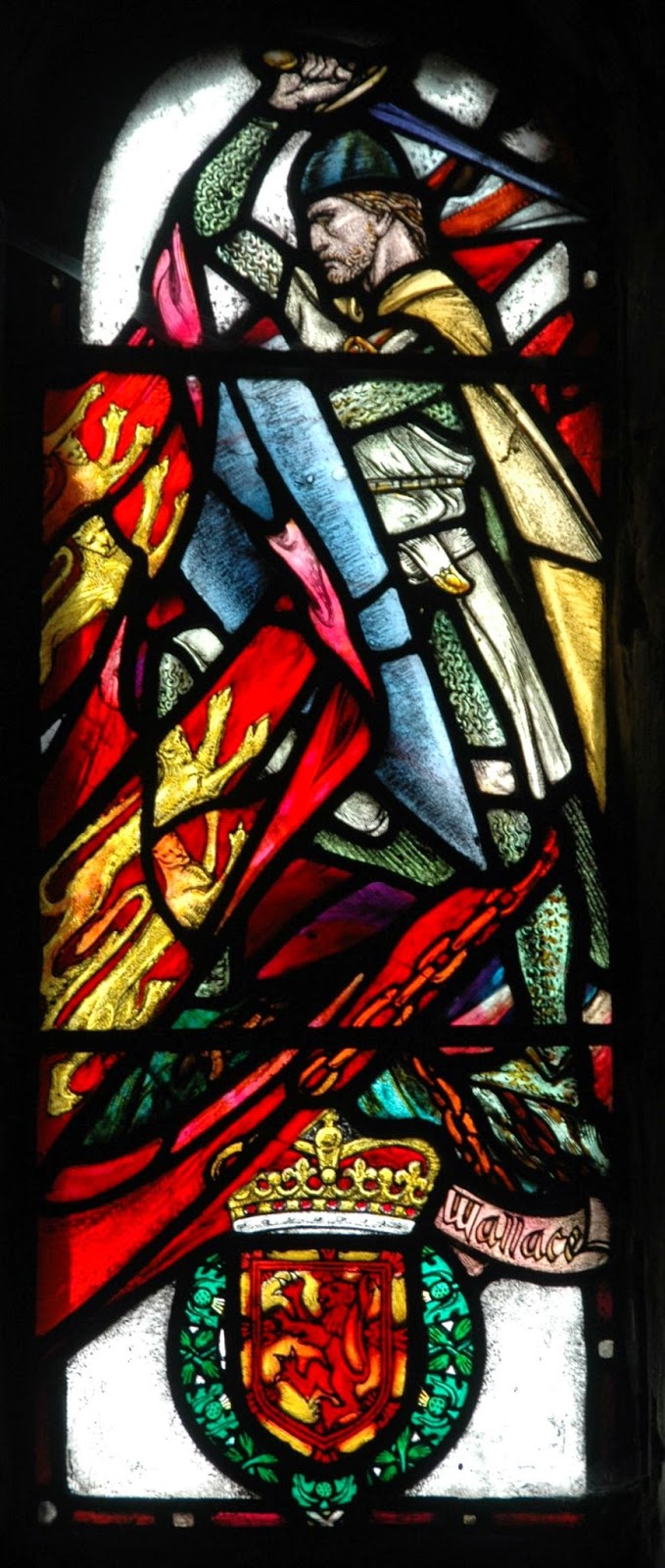
The castle is a functioning regimental barracks (like Fort George), so parts of it are closed to the public. But those parts you can get to are definitely worth the visit. There is a little chapel, St Margaret's Chapel, the oldest existing part of the castle, built in about 1130. There are some modern stained glass windows in there, including one of William Wallace! The little chapel is still used for weddings and christenings!

There is a siege gun, "Mons Meg" (after the Belgian town of Mons where she was made in 1449), which was presented to James II of Scotland in 1457. She could fire a 150kg gunstone about 2 miles. She was last used only as a saluting gun, as she was really too cumbersome for military duty. She is one of the few guns that survived the Disarming Act that followed the Jacobite Risings, simply because her great bulk prevented her from being melted down.

The Scottish Honours (the Scottish Crown Jewels) had an eventful history, having been buried from 1651 to 1660 to keep then from Cromwell. From 1707 they were locked away in the Crown Room, which was broken into by Sir Walter Scott in 1818 (with royal approval) and they again saw the light of day. There is a display that tells their story that, on a quiet day, would allow you time to take it all in, and then spend some time looking at the the Honours themselves, and the Stone of Destiny. The Stone of Destiny, or Stone of Scone, is the stone on which all Scottish kings were crowned, until 1296 when it was forcibly removed and placed in the Coronation Chair in Westminster Abbey. It was only returned to Scotland in 1996! It will be allowed to be "borrowed" for coronations at Westminster, but will be returned immediately to its rightful home in Scotland.


The Great Hall
We went through the Royal Palace, the rooms occupied by Mary, Queen of Scots, when she gave birth to James VI of Scotland (James I of England). The rooms have been refurbished as they would have been in her time. We also went into the Great Hall, completed in 1511. Again, this has had a checkered history (under Cromwell, and as an army barracks for over 230 years), and it is only recently that Historic Scotland has restored it to its original glory. The great hammerbeam roof is original, one of the most important medieval roofs in Britain.


View from the Castle


Museum Main Gallery

After the Castle, we went down a couple of streets south of the Royal Mile to the National Museum of Scotland. This is one of your classic 19th century style museums, although the information carried in the displays is definitely 20th/21st century in content. But you still have your wonderful displays of dinosaur skeletons and stuffed animals, of ethnic artifacts from various cultures both modern and ancient, of geological, astronomical and mechanical wonders.
The entry, through what used to be the basement, is modern, but as soon as you get upstairs you are in this wonderful 19th century steel and glass gallery. We were lucky in that there was a concert being given in the main gallery as part of the Edinburgh Fringe Festival, a piano and violin duo who were really quite good!

And after the museum, we went back up to the Royal Mile to the Museum of Childhood. This is a delightful museum of everything concerned with childhood — clothing, toys, games, education. We just walked around, reminiscing — "I had one just like that!"


By now, the day was drawing to a close, and our feet were beginning to say "No more!", so we got on the bus and back to the Camping Area for the night.

Before we retired for the night we watched the movie "The Angel's Share", a Scottish comedy recommended to us by Kay. If you haven't seen it, try to — it's very Scottish, quirky, and a little bit anti-establishment!

Distance driven — today, nil ; to date, 5,422 miles ( 8,726 km )

Monday, 4 August 2014

4 Aug 2014. <GB-SCT> Edinburgh —
Today we drove to Edinburgh. This time, for a change, we decided to use a Caravan and Camping park, and so came to the Mortonhall site about 4 miles to the south of the centre of Edinburgh. It is well set up on an old Estate, and is very well patronised. We were lucky to get a place. There are buses that run by the park straight into Edinburgh, every 10 minutes. It is so well patronised that the bus company puts a bus just outside the park simply to sell tickets — this is a very good service, as the buses themselves don't accept anything but exact change.

We went into Edinburgh for a look around, and also to see if we could get a new camera lens. We couldn't, but we have good leads for places in Birmingham and Manchester — and Warren is getting used to the lens without autofocus in any case!


Princes Street

Scott Monument

Festival busker


Princes Street buses

Scott in his monument


The Edinburgh Festival starts here in about 4 days, and the Fringe Festival started 4 days ago, as did the Edinburgh Tattoo. The crowds in town are substantial, and the whole place reminds you somewhat of Ekka crowds!

Susie had a chance to get her hair done, Warren at last found a second pair of shoes that he likes, and we sorted out what we want to do in the next couple of days, before returning to the van to settle in for the night.

Distance driven — today, 23 miles ( 37 km ); to date, 5,422 miles ( 8,726 km )

Sunday, 3 August 2014

3 Aug 2014. <GB-SCT> Abbey Crag, Stirling; Linlithgow, West Lothian —
Today the aim was to go up to the National Wallace Monument, on the Abbey Craig, overlooking Stirling and the sites of the Battle of Stirling Bridge (William Wallace, 11 September 1297) and Bannockburn (Robert the Bruce, 23-24 June 1314), and then to the Bridge of Allan Highland games, just down the road.


Statue of Wallace
on Monument
Well, we went up to the Wallace Monument. Shades of Braveheart!! Wallace had a phenomenal career, winning battle honours against Edward I. Wallace became the Guardian of Scotland. Only a year later, Wallace was defeated at Falkirk, in a more traditional battle, but the seeds of Scottish resistance had been sown, which culminated in Bannockburn only 17 years later.

The Battle of Stirling Bridge was influential in other ways. It was a success of a common army of enlisted spearmen against feudal knights in full armour. It also destroyed the myth of English invincibility.

n
Wallace, betrayed into English hands in 1305, was tried by the English, by a court he refused to recognise, found guilty, hanged, disembowelled, beheaded and quartered as a 'rebel' at Smithfield in London. Far from ending Scottish resistance, this provided them with a martyr, and Robert the Bruce dealt the final blow to the English at Bannockburn in 1314.

The monument itself is so truly Scottish as to be an icon in its own right. It was built between 1861 and 1869, using stone quarried from the Abbey Craig itself. There are three levels within the monument, and a viewing platform at the top, from which you can see the battlefields of Stirling Bridge and of Bannockburn. On the first level, you get the history of the Battle of Stirling Bridge; on the second level (the Hall of Heroes) is a display of the busts of 16 Scottish heroes; on the third level, the story of the monument itself.


The view across to Stirling Castle
Anyway, we climbed the 246 steps within the monument (after climbing the Craig itself!), and spent about an hour communing with Wallace. Then we went down to the restaurant at the base of the Craig, where we had coffee and scones (what else!). By this time the heavens had opened, so we decided to give the highland games a miss!

So what to do next? On the way towards Edinburgh is another National Trust property - the House of the Binns. This is not a 'stately home', but the residence of the Dalyell family from the early 1600s to the present.
The property was given over to the National Trust of Scotland in 1946, but the Dalyells are still in residence, with Tam Dalyell, the socialist MP (who is entitled to be styled the 10th Baronet, but because of his philosophy ignores this title). Also in residence are the peacocks, which have been a feature there right from the outset.

In the house is a fine collection of family memorabilia, including a series of cartoons of the current Tam Dalyell, who has had a rather lively time in Parliament and has been the subject of some rather interesting political cartoons in the Times and elsewhere. One very telling one has him as a terrier, nipping at the heels of Margaret Thatcher! His wife Kathleen takes a great interest in the showing of the house to visitors, and in the visitors who come through. She was a most charming hostess while we were there. The house of the Binns is a fascinating place to visit, but we think one of its major assets is Kathleen herself!

We walked the woodland walk up to a folly, a tower built at the top of the hill with a panoramic view of the Firth of Forth and the bridge there. The tower was built in 1826 with the proceeds of a successful wager (£28).


We took our leave, somewhat reluctantly, and continued on towards Edinburgh. We decided to take our journey along some secondary roads, as opposed to the M9 motorway, in the hope of happening upon a good place to camp off, and so we did.
We found a side road down to the Lowlands Canal, with a bike path or tow path alongside it. We watched a barge coming through, and a three-person tandem ride past, a number of ramblers and dog walkers taking advantage of the woodland walks near the canal. A lovely quiet place to park!

Distance driven — today, 35 miles ( 56 km ); to date, 5,399 miles ( 8,689 km )

Saturday, 2 August 2014

2 Aug 2014. <GB-SCT> Stirling, Stirling —
A nothing day. Weather miserable — raining. We spent our day parked in a Sainsbury's car park, with a Macca's next door. We spent our time wandering in Sainsbury's, shopping, or in Macca's drinking coffee and catching up on internet time. At the end of the day, we adjourned to our park below Stirling Castle for a good night's sleep!

Distance driven — today, 2 miles ( 3 km ); to date, 5,364 miles ( 8,633 km )

Friday, 1 August 2014

1 Aug 2014. <GB-SCT> Bannockburn, & Stirling, Stirling —
Today we decided to take a punt, and make for the Battlefield at Bannockburn. It is recommended that you pre-book for the Battle of Bannockburn Experience, but we took the chance and, again, the Hams land on their feet — we were able to get straight in to the next show. And show it is! A guide takes you over a 3D simulation of the battlefield, highlighting points of interest in the computer animation with a laser pointer. This may sound dry, but the animation and its commentary is brilliant, and the 'guide' was a cockney with a cheeky sense of humour — a most entertaining (and informative) 15-minute presentation. We were then let loose on the rest of the centre — a couple of 3D movies introducing Robert the Bruce and Edward II (the two antagonists), and another which tracks the repercussions of Bannockburn. Computer gamers can come in and play an interactive war game on the same battlefield — the show and the game alternate throughout the day in the same room. There are other displays — one of the genealogy and heraldry of the main participants, one with superb computer animations of many of the participants in the battle telling their own stories. And then you are let out to the monuments themselves — the Bannockburn memorial, and a statue of Robert the Bruce that has become iconic.

The memorial has been newly refurbished, because June 23 and 24, 2014, was the 700th anniversatry of the battle. There is a wooden perimeter to the top of the wall round the memorial and flagpole, and it carries a poem newly commisioned for the site:
Here lies our land: Every airt
Beneath swift clouds. Glad glints of sun,
Belonging to none but itself.
We are mere transients, who sing
Its westlin winds and fernie braes,
Northern lights and siller tides,
Small folk playing our part.
Come ye, the country says,
You win me who take me most to heart.

We must also remember that the song Flower of Scotland, by the Corries, now Scotland's sporting anthem (and which Warren hasn't been able get out of his head since singing it with the Brisbane Chorale at Brisbane International Airport to welcome supporters for the Rugby Union tournament held in Ausralia last year), refers to the Battle of Bannockburn:
Oh flower of Scotland, when will we see your likes again,
That fought and died for your wee bit hill and plain,
And fought against him, proud Edward's army,
And sent him hame again tae think again.

'He who holds Stirling, holds Scotland'
Traditional saying
One thing that you cannot do here is to walk the battlefield. The National Trust site is indeed a part of the battlefield, but most of the significant action took place in parts now occupied by the City of Stirling! But the battle was in fact a battle for the possession of Stirling Castle. If Sir Phillip Mowbray did not vacate Stirling Castle by midsummer's day, 1314, battle would be joined. It was a little more complicated, but in essence, this is what happened. After the battle, Mowbray was denied entrance back into the castle, and had to slink away. So Stirling Castle, another part of the Bannockburn story, was the next place we visited.

Chapel

The Great Hall

The Queen's Bedroom


One of the Unicorn Tapestries


A Guide for the Children!
Stirling Castle has a long history, but from 1794 to 1964 it was used as a military barracks for various Scottish army units, being allowed to lose all of its splendour, and falling into a state of disrepair. In 1906 Edward VII transferred its responsibility from the War Office to the Office of Works (now Historic Scotland), who, once the military took their leave, have refurbished the castle magnificently, and it is now a joy to go through it. Tapestries have been prepared to replace the ones that have been lost, the rooms have been repainted to their former glory, the Stirling Heads — panels with painted wooden heads that once graced the King's Inner Hall of James V (of Scotland), and which had made their way into private hands or had been lost completely — have been retrieved or recreated from drawings by Jane Ferrier (1767-1846), who had tracked most of them down.

We spent fully 4 hours exploring Stirling Castle, then left to check out how we could get to the Wallace Memorial tomorrow morning. Having done that, we retired to a parking area just beneath Stirling Castle — not a bad view to wake up to in the morning!

Distance driven — today, 31 miles ( 50 km ); to date, 5,362 miles ( 8,630 km )